.png)
Introduction
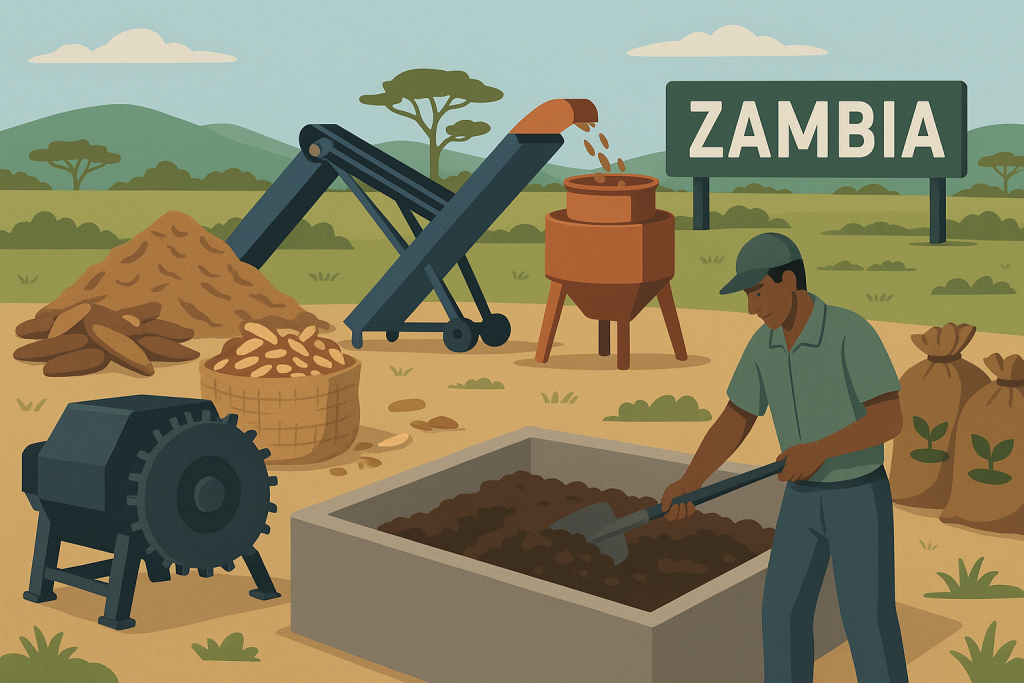
Every tonne of processed cassava in Zambia leaves behind roughly one‑third of its weight in peels—material that is usually dumped or burned. Yet those cassava peels can become a nutrient‑rich, organic fertilizer that improves soil health, lifts yields, and keeps money in farmers’ pockets. This article explores how to launch a cassava peel organic fertilizer venture in Zambia, covering regulatory approvals, production technology, capital costs, and the demand landscape.
1. Regulatory Roadmap
1.1 Environmental Impact Approvals (ZEMA)
Before building any fertilizer plant, entrepreneurs must clear Zambia Environmental Management Agency (ZEMA) requirements under the Environmental Management Act of 2011. The basic steps are:
-
Screening – Submit an Environmental Project Brief (EPB). ZEMA decides whether a full Environmental Impact Assessment (EIA) is needed.
-
Scoping & Assessment – If required, develop Terms of Reference, conduct studies, and compile the EIA.
-
Review & Decision – ZEMA circulates the report internally and externally before granting (or refusing) an environmental authorisation licence.
-
Fees & Monitoring – Pay review fees and comply with ongoing inspection or reporting obligations.
Early engagement with ZEMA reduces costly redesigns later.
1.2 Fertilizer‑Specific Licences
Under the Agriculture (Fertilisers and Feed) Act, every fertilizer plant must:
-
Register the facility and its products with the Registering Officer (usually within Zambia Agriculture Research Institute, ZARI).
-
Meet purity and nutrient standards set by ZARI labs; sub‑standard batches face seizure.
-
Undergo random checks by the Zambia Compulsory Standards Agency (ZCSA) for fertilizers that fall under compulsory standards.
Tip: Build product testing into your budget and timeline from day one.
2. Turning Peels into Profits – Production Options
2.1 Composting
Aerobic windrow or groove composting is straightforward. Mix shredded cassava peels with nitrogen‑rich residues (e.g., poultry litter) to balance the carbon‑to‑nitrogen (C:N) ratio around 25:1, keep moisture near 55 %, and turn piles weekly. After 8‑10 weeks the material stabilises into crumbly, pathogen‑free compost.
2.2 Vermicomposting
Introduce African night‑crawler worms (Eudrilus eugeniae) to partially pre‑composted peels blended 50:50 with cow dung. Worms accelerate conversion, producing a fine “black gold” loaded with beneficial microbes in as little as 40 days. Farmers prize vermicast for seedling production.
2.3 Controlled Fermentation
Larger plants often prefer in‑vessel composters or tunnel fermenters: peels are shredded, inoculated with specialised microbes, dosed with 10–20 % chicken manure, and oxygenated mechanically. Temperature stays above 55 °C long enough to kill weed seeds, yet odours remain contained—useful near towns.
3. Equipment & Capital Requirements
| Scale | Throughput (t/h) | Core Equipment | Typical CapEx (USD) | Notes | | Small pilot | 1–3 | Mobile compost turner, simple shredder, bagging scales | 100 000–150 000 | Ideal for cooperatives or out‑grower schemes | | Medium | 5–10 | Groove or wheel turner, hammer mill, rotary screener, granulator | 150 000–350 000 | Can hit 25 000 t/year with one shift | | Large | 10–20 | Automated in‑vessel unit, multi‑stage granulation line, bulk loaders | 350 000–500 000 | Suitable for national brands; integrate with cassava‑starch factory |
A full 50 000 t/year plant—including civil works, QA lab, forklifts, and working capital—can reach about $10 million, yet models show payback in four years and internal rates of return above 30 %. Start‑ups often launch small, prove demand, then scale with retained earnings or development‑finance loans.
4. Market Demand – Why Farmers Are Switching
-
Rising fertilizer use: Nearly 60 % of smallholders now apply some fertilizer, and average application rates grew 21 % in recent seasons.
-
Soil fatigue: Heavy reliance on synthetic NPK has depleted organic matter; growers welcome a soil‑building alternative.
-
Policy tailwinds: Traditional leaders and extension officers increasingly recommend organic inputs to protect water bodies and reduce import bills pegged to volatile exchange rates.
-
Yield proof: Field trials show cassava‑peel bio‑fertilizer lifting cassava yields by over 35 % and boosting maize and vegetable performance thanks to slower nutrient release and improved moisture retention.
Central and Eastern Provinces—where cassava processing clusters meet high fertilizer uptake—offer prime launch sites. A hub‑and‑spoke distribution model with depots in each province cuts transport costs and widens reach.
5. Implementation Blueprint
-
Secure Feedstock – Sign offtake agreements with cassava chips or gari producers. A mid‑sized facility needs roughly 30 000 t of peels per year.
-
Pick the Site – Prioritise industrial zones with road access, grid power, and buffer land for odour management. The Zambia Development Agency lists serviced land near Choma ideal for agri‑processing.
-
Design for Modularity – Select equipment that scales; e.g., add extra fermentation tunnels instead of replacing the whole line.
-
Quality & Branding – Conduct routine NPK and microbiological tests; position your label around “soil‑smart” performance rather than just “organic”.
-
Farmer Education – Demonstrate side‑by‑side plot trials, provide dosage guides, and partner with agro‑dealers and cooperatives to build trust.
-
Finance Mix – Blend equity, concessional green‑growth loans, and potentially carbon‑credit revenue if you document methane‑avoidance benefits.
Conclusion
Zambia’s cassava boom creates a peel mountain that, with smart technology and clear regulatory compliance, can morph into a high‑margin organic fertilizer. Entrepreneurs who secure raw‑material partnerships, follow ZEMA and Fertiliser Act requirements, and invest in scalable composting systems stand to tap a market hungry for eco‑friendly nutrients. Beyond profits, they will cut waste, enrich soils, and bolster food security—proving that green business can also be good business.